

There is an old saying in the angling world: “Big bait, big fish.” If you are tired of catching small panfish and are ready to land a personal best, it’s time to change your strategy. Enter the world of swim bait lures. These aren’t your average lures; they are precision-engineered imitations designed to fool the largest, smartest predators in the lake.
While a standard lure might get a curious glance, a properly fished swimbait triggers a predatory instinct that fish simply cannot resist. In this guide, we will explore why these fishing baits and lures are so effective and teach you the pro techniques to master the “S-curve.”
What are Swim Bait Lures and Why are They So Effective?
Swimbaits differ from other artificial lures because of their incredible realism. They are designed to look, move, and even vibrate exactly like a live baitfish.
Mimicking Real Prey: The Visual Advantage
A large bass or pike has seen a thousand spinnerbaits. But a swimbait with a realistic profile and natural color pattern looks like a meal they’ve eaten a hundred times. This visual confidence is what leads to those heart-stopping strikes.
Lateral Line Stimulation: Water Displacement
Fish don’t just see prey; they feel it. The large body of a swimbait moves a significant amount of water, creating vibrations that a predator’s lateral line picks up from a distance. It’s like a dinner bell ringing through the water column.
Types of Swim Baits: Hard vs. Soft Baits
Understanding the two main categories of swim bait lures is key to choosing the right tool for the job.
- Soft Paddle Tail Swimbaits: These are made of flexible plastic with a “boot” tail that thumps as it moves. They are great for fishing through weeds and cover.
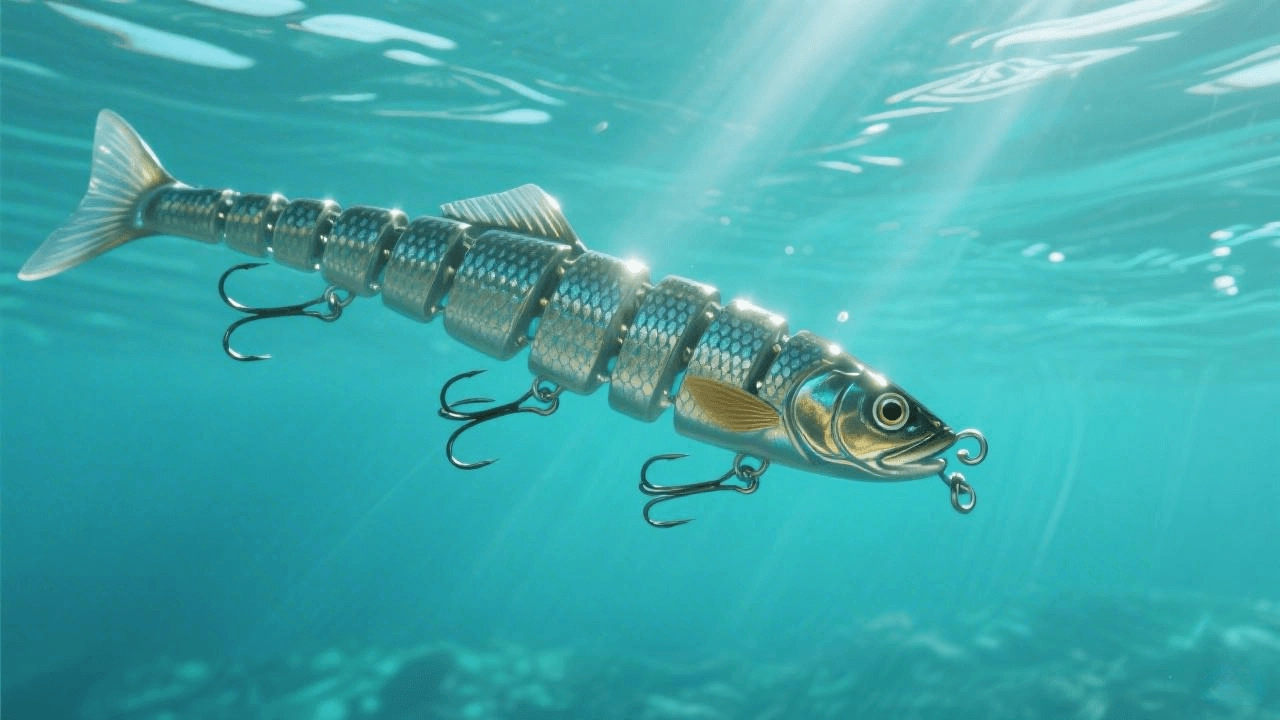
- Hard Multi-Section Swimbaits: These are the masterpieces of lure design. Built with multiple joints, they create a fluid, lifelike swimming motion that is impossible to achieve with a single-piece lure.
Mastering the Multi-Section Swimbait Technique
The multi-section swimbait is famous for its “S-Curve” action. When you retrieve it, the segments hinge back and forth, making the lure glide in a wide, natural “S” pattern.
The Steady Retrieve: The “S-Curve” Swim
The most basic technique is the most effective. Keep your rod tip down and reel at a slow to medium pace. The lure will do the work for you, swimming exactly like a relaxed trout or shad.
The Stop-and-Go: Mimicking Injury
When you stop reeling, a jointed swimbait will often coast and slowly turn to the side. This looks exactly like a dying baitfish—an easy, high-calorie meal that big fish crave.
Twitching and Gliding
Give your reel handle a quick half-turn or “pop” your rod tip. This causes the swimbait to dart aggressively, often triggering a “reaction strike” from a fish that was just following the lure.
Where and When to Throw Swim Bait Lures
Swimbaits are highly effective, but they work best in specific conditions.
- Clear Water Conditions: Because they rely on visual realism, swimbaits are deadly in clear water where fish can see the detail. If you are learning how to fish for largemouth bass in deep, clear reservoirs, this is your secret weapon.
- Fishing Near Structure: Cast parallel to steep drop-offs, bridge pilings, or large fallen trees. Big predators use these spots to ambush larger prey.
Pro Setup: The Gear You Need for Big Baits
You cannot throw heavy swimbaits on light gear. You need a setup that can handle the weight of the lure and the power of the fish.
- Rod Selection: Look for a Medium-Heavy or Heavy power rod with a fast action. You need the “backbone” to cast a 1-ounce lure and set a large hook.
- Line Choice: Since you are targeting big fish, choosing the right fishing line is vital. We recommend 20lb+ braided line with a heavy fluorocarbon leader for the best combination of strength and invisibility.
Ready to Land Your Personal Best?
Swimbait fishing is a game of patience and precision. You might get fewer bites than you would with a small worm, but the bites you do get will be the fish you remember for the rest of your life.
Ready to upgrade your arsenal? Explore our collection of high-performance lures and experience the power of the multi-section swimbait for yourself.
FAQ: Common Questions About Swimbait Fishing
Q1: Are swimbaits only for bass?
Not at all! While they are legendary for bass, multi-section swimbaits are incredibly effective for Northern Pike, Muskie, Walleye, and even many inshore saltwater species like Snook and Redfish.
Q2: Do I need specialized expensive gear for heavy swimbaits?
While pro-level swimbait rods exist, a high-quality, versatile Medium-Heavy carbon fiber rod will handle most standard-sized swimbaits (up to 1.5 oz) perfectly well. Focus on quality, not just price.
Q3: How do I choose the right color for my swimbait?
Always try to “match the hatch.” If your lake is full of shad, use silver or white. If there are trout, use a pattern with pink and green accents. When in doubt, a natural “Ghost Minnow” or “Green Pumpkin” pattern works almost anywhere. Find your perfect match by browsing our lure selection.