
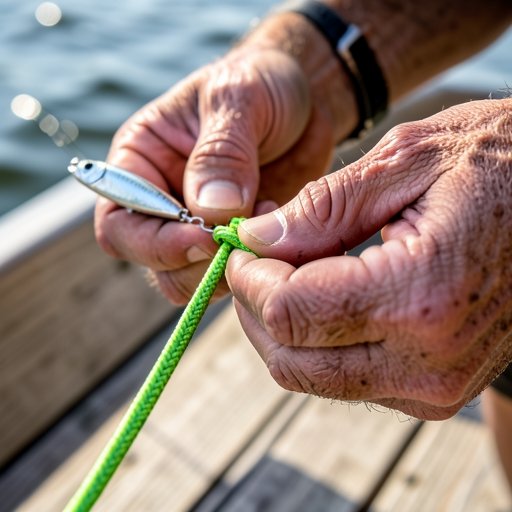
There is no feeling quite as heartbreaking as hooking a massive fish, feeling its power for a few seconds, and then suddenly… the line goes limp. You reel in only to find a curly, pigtail-shaped end of your line. Your knot failed.
Statistics show that 90% of “line breaks” are actually knot failures. For a beginner, the world of line connections can seem complex, but you only need a few reliable tools. This guide covers the best fishing knots for beginners, ensuring your connection to the water is indestructible. To ensure your knots hold tight, always start with a high-performance braid fishing line.
Why Knot Strength is the Secret to Fishing Success
A knot is technically the weakest point in your entire setup. When you tie a knot, you are essentially kinking and compressing the line.
Understanding Friction and Heat
The biggest enemy of a knot is heat caused by friction. When you pull a knot tight, the line rubs against itself. If the line is dry, this friction creates microscopic heat damage that weakens the fibers. Pro Tip: Always wet your knot with water or saliva before pulling it tight.
Why Braided Line Requires Special Knots
Braided line is incredibly slick. Standard knots that work for monofilament will often slide right out of braid. Mastering specific braid fishing line knots is essential if you want to use modern PE lines effectively.
Knot #1: The Palomar Knot (The Strongest for Lures)
The Palomar knot is widely considered the strongest knot for tying a lure or hook to your line, especially when using braid. It is nearly impossible to tie incorrectly and retains almost 100% of the line’s original strength.
- Best For: Connecting lures, snaps, or hooks to braid or fluorocarbon.
- Why it Wins: It doubles the line through the eye of the hook, providing extra security.
Knot #2: The Uni Knot (The Most Versatile All-Rounder)
If you only learn one knot, make it the Uni knot. It is the “Swiss Army Knife” of the fishing world. You can use it to tie on a hook, or even to join two lines together.
- Best For: Almost any application with monofilament or fluorocarbon.
- How to Tie: Loop the line, wrap the tag end around the standing line 5-6 times inside the loop, and pull tight.
Knot #3: The Double Uni Knot (Connecting Braid to Leader)
As we’ve discussed in our guide to fluorocarbon leader lines, a leader is vital for stealth. The Double Uni knot is the easiest way to connect your main braided line to your leader. It involves tying two Uni knots that slide together and jam against each other.
Knot #4: The Improved Clinch Knot (The Classic)
This is the knot most of our grandfathers taught us. While not as strong as the Palomar for braid, it is a very fast and reliable way to tie a hook when using standard monofilament line.
Knot #5: The Arbor Knot (Starting Your Setup)
You can’t catch a fish if your line isn’t attached to your reel! The Arbor knot is a simple “slip knot” used to secure your line to the reel spool. It ensures that if a monster fish ever pulls all your line out, the end won’t just slide off the spool.
Pro Tips for Tying Perfect Knots Every Time
- Lubricate: We cannot stress this enough—wet the knot before tightening.
- Pull Slowly: Don’t snap the knot shut. Pull it with steady, firm pressure.
- Trim the “Tag End”: Use sharp cutters to trim the excess line about 1/8th of an inch from the knot. Don’t cut it too close, or it might slip under extreme pressure.
- Test It: Always give your lure a hard tug before you cast. If the knot is going to fail, you want it to fail in your hand, not in a fish’s mouth.
Conclusion: Practice Makes Perfect
Mastering these five knots will give you the confidence to handle 99% of all fishing situations. Don’t wait until you are on the water to learn; grab a spool of line and practice while watching a movie. Once these knots become muscle memory, you’ll spend less time fiddling with gear and more time catching fish.
Ready to test your new skills? Explore our collection of premium gear and get ready for your most successful trip yet.
FAQ: Common Fishing Knot Problems
Q1: Why does my knot keep slipping with braided line? A: Braided line is very slippery. You likely used a knot like the Clinch knot which isn’t designed for braid. Switch to the Palomar or increase the number of wraps in your Uni knot to at least 8.
Q2: How often should I re-tie my knots? A: You should re-tie after catching a particularly large fish, or if you feel your line has rubbed against rocks or structure. As a rule of thumb, re-tying every few hours of active fishing is a good habit.
Q3: Does the knot size matter? A: Yes, especially for leaders. A bulky knot will hit your rod guides, reducing casting distance. This is why the Double Uni is preferred—it is strong yet slim. Find everything you need for a professional setup by visiting our shop.